7 Simple Steps to Enhance Your LinkedIn Profile

A major part of representing your Human Resources department is having an accessible professional presence not only at your organization, but in cyberspace as well. One of the best ways to establish this presence is to have a respectable LinkedIn profile. If you haven’t spent much time on LinkedIn yet, the task of setting up and maintaining that profile may seem a bit daunting, especially if, like many professionals, your time is limited. Following the recommendations below will enable you to create a complete basic LinkedIn profile in addition to laying a solid foundation you can build on later. Depending on your starting point, you can tackle these to dos in as little as 1-2 hours.

Note: Before you get started, check to see if your employer has created guidelines for you to follow. Since they’re paying your salary and you’re representing their brand, they have a say in how you represent them and your role. 

#1: Set Your Profile to Public

Given the purpose of LinkedIn, it’s hard to understand why anyone would want their profile to be private or anonymous, but many people are still hesitant to let their presence be known. Here are three good reasons why you should opt for a public profile:

  1. If you have an externally-facing role and/or are a senior professional, people you may interact with will look for your profile to learn more about you.  As more and more people come to rely on LinkedIn as a resource, it will increasingly strike people as odd if they can’t find you. That’s not a good reflection on either your professional brand or your organization.
  2. With an anonymous profile, you are referred to in LinkedIn as “private private,” which can look really silly. It’s especially funny when someone with a private profile gets recommended by someone else. I’ve lost count of the number of notifications from my first-level connections that will say something like: Jane Doe has recommended private private: “I worked with Bob Smith at XYZ…” So much for anonymity!
  3. If people want to find your profile, they can. I can’t reveal the trick, but resourceful LinkedIn users know how to access profiles using people’s LinkedIn member numbers. It’s a very simple workaround.

#2: Add a Respectable Profile Picture

As in most social networks, there’s a normative expectation that people have a profile picture. If you don’t, people will either assume that you don’t know what you’re doing or that you have something to hide. Including a profile picture prevents the speculation and lets you control the initial impression people get when they view your profile.

Depending on their jobs, industries, and reputations, some people on LinkedIn can get away with more daring profile pictures. For most of us, however, a conservative approach is best. Here are some tips that will work for most people:

  • Use an image that reflects your professional identity, not your personal identity.
  • If you use a photo of yourself, make sure it’s current and of decent quality. Only include yourself in the photo and be sure the focus is on your face (i.e., a headshot).
  • If you don’t want to use a photo of yourself, find an image that reflects your values, capabilities or essence in some way. Be careful about using things that are too cutesy or may involve questionable humor.

#3: Include a Headline

To me, the LinkedIn headline is better in concept than in reality. Personally, I’ve always struggled with what to include, and I’ve never been completely satisfied with what I’ve come up with. But since it’s something of a “necessary evil,” you have to try to make the best of it. Here are a few suggestions based on my own experience and my review of hundreds (if not thousands) of profiles:

  • Short descriptors separated by bars are probably easier than trying to craft a sentence.
  • Focus on what you offer, not what you want (e.g., don’t say you’re looking for a job).
  • Avoid bland descriptions like “experienced accountant”.
  • Highlight your unique professional capabilities and/or character using key words that will catch people’s attention.
  • If you’re currently employed, it’s perfectly acceptable to include your current job title.

 #4: Provide a Robust Description for Your Current Job

Even if you don’t have time to fully flesh out your profile, you should at least provide a robust description of your current position. This is especially true for folks in externally-facing roles like recruiting, human resources, public relations, marketing, sales, and business development. You should also at least list all your previous employers/positions–certainly the most recent/relevant ones.

Generally speaking, the description you provide in your LinkedIn profile is the same as what you’d include on a resume. So if your resume is current, you should be able to just cut and paste titles and text from that document to the data entry boxes on LinkedIn. If your resume isn’t current, this is a great opportunity to update it!

Additional Job Description Tips:

  • Be sure to link the job to your employer’s Company Page. If they don’t have one, suggest they set one up – pronto!
  • Limit your description of the organization to 1-2 sentences. If people want to learn more, they can go to the Company Page.
  • Also limit your description of the job and your responsibilities as much as possible, focusing instead on unique contributions, value added, and accomplishments.
  • Remember that you’re writing for both search engines and human beings. That means your descriptions should be key word rich, but they also need to be attractive and readable by people.
  • When in doubt, leave it out. The profile should entice people to want to learn more rather than try to tell your whole life story. The less relevant a job is to your current professional activities, the less you should say about it.

If you have any professional certifications, be sure to list them in the Certifications section. Similarly, if they’re relevant to your current professional activities, you can also list honors and awards. Both sections can be completed in mere minutes.

#5: Include Your Education

As with some of your older work experiences, you can take a “name/rank/serial” number approach to providing information about your academic background. You should definitely list all the schools you attended and/or got degrees from, but you don’t need to provide more detail than your degree program and the years attended. And yes, I would include the years. If you don’t, people will naturally conclude that you’re trying to hide the fact that it was a long time ago, so not listing them doesn’t protect you from discrimination. Besides, if someone is going to discriminate against you based on your age, you probably don’t want to work with them anyway.

 #6: Don’t Include Personal Information

I don’t know why LinkedIn provides these fields, but I would recommend against including personal information such as your address, marital status, and date of birth. This information is generally not relevant to your professional identity or interactions.

#7: Enable People to Get in Touch with You

Related to the fear of having a public profile, many professionals seem to be afraid that if they don’t restrict access to themselves they will be inundated with and overwhelmed by a variety of requests. In my experience, the fear is greater than the reality. I recommend lowering the drawbridge and letting people contact you through every available LinkedIn channel. And if you’re in a job like business development or recruiting, you own your own business, or are on the job market, make it easy for people to get in touch with you outside of LinkedIn as well by adding a statement under your Contact Settings that shares your contact information. Here’s a sample statement:

I can be reached directly via email at name@organization.com, or via phone at 312-555-1212.

To make it easier to manage inappropriate requests, clearly specify the kinds of opportunities you’re open to hearing about.


This article was originally published by Social Media in Organizations (SMinOrgs).
3 Reasons You Must Constantly Innovate

Let’s say your company is the clear market leader: your product was the first on the field. Nobody else comes close in terms of quality and customer service. Maybe you even hold a patent. In that case, you can relax. There’s no immediate need to focus on research and development or new innovations, right? Wrong. There are three critical reasons that all firms need to constantly innovate.

1. Pioneering advantage

The first entrant into the marketplace maintains a competitive edge, and you want to be the market leader: not only in terms of being out there first, which puts you in a position to enjoy a monopoly-like status, but also to position yourself to be able to capitalize on that early win.

 2. Product life cycle

History shows that sales of products will grow initially after introduction, but they’ll decline over time. To maintain market share, you’re going to have to introduce new products that customers want. As you’re considering how to innovate, you’ll want to use marketing research methods that help you identify consumers’ wants and needs.

3. Market share will erode as competitors move in

This is true particularly in the case of patent holders whose patents expire, such as pharmaceutical companies whose market share for their patented drug erodes when generics come on the market and begin to compete. Analyzing customer preferences and using that data to drive innovations will position you to maintain market share.

The Moneyball Effect: How Data Will Transform Student Success in 10 Years

In his 2003 book “Moneyball,” bestselling author Michael Lewis chronicled the 2002 Oakland Athletics baseball team’s unprecedented run to win their division championship through a specialized analysis of baseball data called “Sabermetrics” (also referred to as “Moneyball”).

By analyzing objective, evidence-based data on historical player performance, the cash-strapped Oakland team built a repeatable, winning strategy that challenged conventional baseball wisdom. More than a decade later, the vast majority of professional sports teams — including the Dallas Mavericks, Los Angeles Clippers and Tampa Bay Rays — now employ statisticians and data analysts to turn player data into actionable coaching insights.

Just as player analytics have transformed decision making in professional sports teams, higher education and learning organizations will use student analytics to transform teaching models, better meet students’ needs and improve learning outcomes over the next decade.

Let’s explore how three types of learning analysis — predictive, adaptive and personalized — will harness the power of student metrics to impact performance.

1. Predictive learning analysis

Whether online or in the classroom, students today interact with various data systems. Learning management and student information systems are chronicles of students’ past and current learning activities. By analyzing this data using evidence-based research, organizations can identify trends, behaviors and patterns to better predict student outcomes at the individual and group level.

For example, learning organizations will analyze:

  • Time spent in class and online, relative to course completion rates;
  • Engagement with faculty, relative to outcomes;
  • Interim assessment scores, relative to final grades; and
  • Prerequisite knowledge and coursework, relative to success rates.

The most powerful predictive data is historical data, so it will be the accumulation of data longitudinally that will become particularly predictive and interesting. With predictive analysis, organizations will gain objective insights into student behaviors and the ability to adapt and personalize future learning to improve student retention and success.

2. Adaptive learning analysis

Combined with predictive analytics, organizations will use adaptive learning analysis to identify individual student needs and quickly intervene to improve the odds of success. Student metrics — such as learning time, response latency, engagement levels and assessment results — form the basis for these analyses.

Armed with these insights, instructors will:

  • Redefine student inputs based on successful outcomes;
  • Adapt assessments, relative to past performance;
  • Adjust student interaction dynamically;
  • Provide on-demand tutoring based on responses; and
  • Offer real-time prompts, clues and grading.

Beyond simply making adjustments to the course materials and delivery pace to improve student retention and outcomes is the ability to constantly and iteratively test those changes. As suggested in a recent article by Chris Proulx, “Three Archetypes of the Future Post-Secondary Instructor,” he suggests the emergence of the “Course Hacker” role in higher education, where:

“…the Course Hacker would be a faculty member with strong technical and statistical skills who would study data about which course assets were being used and by whom, which students worked more quickly or slowly, which questions caused the most problems on a quiz, who were the most socially active students in the course, who were the lurkers but getting high marks, etc.  Armed with those deep insights, they would be continually adapting course content, providing support and remedial help to targeted students, creating incentives to motivate people past critical blocks in the course, etc.”

For example:

“The data tells us that this student is having a hard time getting through the materials in the allotted time. Let’s make Tweak A and see if that improves course completion. No? Let’s try Tweak B and compare the data.”

And as large-scale participation courses, such as MOOCs (massive open online courses), become more prevalent over the next decade, adaptive learning analysis will allow learning organizations to provide scalable, agile interaction to meet the unique needs of individual students.

3. Personalized learning

As organizations use analytics to better understand students’ distinct learning behavior profiles, it will open the door to personalized learning. Where adaptive learning is used to quickly intervene when students are struggling, personalized learning focuses on providing the student with choices to determine when, what and how they learn.

For example, organizations will personalize learning by:

  • Adjusting the pace of learning;
  • Creating personalized learning paths based on interest and existing knowledge;
  • Localizing the curriculum to regional or cultural needs;
  • Developing communities of similar students;
  • Offering alternate learning times to accommodate personal schedules; and
  • Using algorithms to dynamically create peer-to-peer relationships.

Winning: Data analytics to drive student performance

Already, new technology tools are making it easier for learning organizations to access and analyze student metrics. But data alone is not actionable information. Instead, learning organizations need objective analytics that help them predict, adapt and personalize their pedagogy to maximize learning outcomes online or in the classroom. Over the next decade, organizations that can do this, and do it well, will prove to be the winners.

Guest Post on The Evolllution

Three Archetypes of the Future Post-Secondary Instructor

Since the dawn of electronic media and its role in higher education, we have been hearing about the end of the “sage on the stage” and the emergence of the “guide on the side.”

In the past decade, we have seen many faculty members embrace the transformation of their role: delivering live video chats, facilitating online discussions in the wee hours of the morning and reviewing online student portfolios.  Yet, at the same time, many faculty have also embraced media to capture their “sage on the stage” lectures for the students in their online courses without much additional pedagogical innovation.

As we look into the next decade, we can imagine a set of online instructor archetypes that will provide a more nuanced spectrum of roles and skills originally envisioned for them.  Let’s meet the “celebrity free agent,” the “ever-connected coach” and the “course hacker.”

The Celebrity Free Agent

When Sebastian Thrun left Stanford University to start Udacity, a massive open online course (MOOC) provider, many began to wonder aloud whether this would be the end of the traditional faculty-university relationship.  If star-powered faculty at major universities could strike out on their own, or perhaps form partnerships and affiliations with each other, could they begin to erode market share from the traditional institutions?  Time will tell.  Certainly, we can expect more faculty members who have top-ranked credentials and excellent presence on-screen to leverage their expertise into powerful new educational brands. These projects will feature more knowledge dissemination than active instruction, but could easily provide both students and institutions with new options. Evidenced by the 100,000+ students registered for Thrun’s MOOC offered through Udacity, or the recent online course project between Clay Christensen and the University of Phoenix, one can see how the traditional measures of faculty-institutional loyalties will be challenged in the next decade.

The Ever-Connected Coach

For many instructors without the star-power of a Thrun or Christensen, the online environment will provide other opportunities for role differentiation. This archetype is the closest to the notion of the “guide on the side.” Using a wide range of social media and networking tools, the Ever-Connected Coach can shift from disseminator of knowledge to learning coach. They might provide an ongoing stream of articles, tips and insights via Twitter. They could form user communities made up of current and past students and employers on LinkedIn to help students master skills that increase their employability, as well as build networks to help them succeed post-course and post-graduation. Conceivably, these instructors might realize they too could break formal ties with the institution, allowing them a more flexible and mobile lifestyle. The next-generation model is similar to that of StraighterLine, a low-cost online education provider, but focused on providing institutions with an in-demand pool of online instructors (excluding the ready-made course content), organized by discipline and highly trained in a set of online, social and mobile tools that maximize learner engagement and retention. An institution looking to scale a program might pair a celebrity faculty member or MOOC with a team of instructors or coaches from an online provider to add a higher level of engagement.

The Course Hacker

The last and perhaps most speculative role of the future online instructor will be the person who digs deep into the data that will be available from next generation learning systems to target specific learning interventions to specific students — at scale. The idea of the Course Hacker is based on the emerging role of the Growth Hacker at high-growth web businesses. Mining data from web traffic, social media, email campaigns, etc., the Growth Hacker is constantly iterating a web product or marketing campaign to seek rapid growth in users or revenue. Adapted to online education, the Course Hacker would be a faculty member with strong technical and statistical skills who would study data about which course assets were being used and by whom, which students worked more quickly or slowly, which questions caused the most problems on a quiz, who were the most socially active students in the course, who were the lurkers but getting high marks, etc.  Armed with those deep insights, they would be continually adapting course content, providing support and remedial help to targeted students, creating incentives to motivate people past critical blocks in the course, etc.

In the coming decade, faculty will have a range of tools to make content more accessible and engaging, better platforms and systems to connect with learners (and connect learners to each other and the broader world) and more data than they ever imagined about how students learn. While some may choose to further specialize with respect to how they teach online — going deep — many will incorporate some aspects of each of these archetypes and become even more effective online instructors, ever-seeking to improve learning outcomes.

Guest Post on The Evolllution


Everything I Ever Needed to Know I Learned at SXSW

Call me an early adopter. Since graduating from Cornell’s School of Hotel Administration in ’03 – I’ve implemented digital marketing strategies for 65 hotels located everywhere from Atlantic City (holy rollers!) to Jerusalem (holy cow!). From San Francisco to South Beach, the digital marketing world moves at the speed of light. In order to keep up, hospitality marketers often have to look outside the industry.

SXSW Interactive, (aka today’s marketer’s Disneyworld), is a great place to catch wind of emerging interactive trends. In anticipation of SXSW Interactive 2013, I took a look back at my big 3 takeaways from SXSW Interactive 2012 (still totally relevant to today’s hospitality marketer!). 

You Are What You Curate: Content is King

Content is viral & short lived. Managing it across your touch points is time consuming. But, give me good content all day long, because good content is a marketer’s best friend. It doesn’t matter if you’re selling a two- or four-star property; your physical room ain’t going to sell itself in today’s competitive marketplace. Dismissing content that engages consumers is a lost opportunity. You’re only as good as the company you keep, so choose your content partners wisely. Associating your brand or hotel with the “right” partners is a quick & dirty way to build cachet & generate buzz.

At SLS South Beach, we recently brought on Net-A-Porter & Mr. Porter as content partners during Art Basel. Net a Porter was willing to create a co-branded SLS South Beach site, featuring Art Basel worthy looks for guests. Additionally, they’d offer free same day shipping for SLS South Beach guests.

In exchange, we agreed to promote the SLS / Net-a-Porter site across our social, web, email, & in room iPad touch points. The cross promotion was a win-win for both partners. Net a Porter gained some sales, but moreover, each brand leveraged the other’s audience to promote a cool piece of content that added to their user/guest experience & brand cachet.

Capitalize on Consumer FOMO

FOMO is the uneasy and sometimes all-consuming feeling that you’re missing out on something that your peers are doing, in the know about, or in possession of more or something better. FOMO may be a social angst that’s always existed, but it’s going into overdrive, thanks to real time digital/social updates, and to our constant companion, the smartphone. Smart marketers manifest FOMO in social media-heavy viral-prone campaigns.

To build buzz on the Grand Opening of SLS South Beach and promote Hyde Beach, the hotel’s day/nightclub, we launched the “Hyde Beach Escape Sweepstakes”. We created a PR-worthy package, chock full of indulgent glamour & promoted it across our channels with “last chance” and “limited time only” messaging in order to create urgency and, of course, jealousy. The campaign’s success was multi-faceted–we gained hundreds of new Facebook followers & ended up selecting a socially influential winner amongst hundreds of applicants.  To top it off, we even sold a few Hyde Beach Escape packages for those who couldn’t wait to win!

Practice Agile Marketing

As an interactive marketer, you want to capitalize on consumer’s FoMo. But, suffering from FoMo in your professional life, can be dangerousFor example, just because the hotel down the street hopped onto Spotify doesn’t mean it’s the right social strategy for your property. Social media may be cheap, but it’s certainly not free. Engaging social content & community management requires time & human capital – better to build a community than to build empty house (or profile). Get your Facebook timeline strategy in place,  & chances are you can apply what you learned to the next hot social media platform. Stay nimble & plan in six-month broad strokes. Plan like the industry moves, allowing your strategy to remain nimble & needs based. Work on a great piece of content & get your Facebook Timeline strategy in place before hopping onto the next emerging platform.

Key Takeaways

  • When producing content, audience is the primary focus. – Ask: What would my audience love?
  • We’re moving toward a feed-based system, and companies will have an increasingly tough time squeezing in overly promotional content. For this reason, brands have to be entertainers. – Think beyond your product, evoke emotion, think lifestyle. capitalize on consumer FOMO!
  • Great content published on a persistent basis takes an enormous amount of work, but smart brands understand it can have a powerful impact – Quality over quantity, practice agile marketing.

Responsive Web Design, Demystified

Background

The explosion of the mobile and social media channels and the emergence of the new tablet channel present a major challenge to hotel marketers: Creating and managing digital content across three distinct distribution and marketing channels (desktop, mobile, tablet), as well as publishing the hotel’s latest special offers and promotions on the hotel’s social media profiles.

Over the past few years, industry experts have projected staggering growth rates in leisure and unmanaged business travel bookings via the mobile channel: from $753 million in 2011 to $1,368 million in 2012 (PhoCusWright), and have advised hoteliers repeatedly to embrace the mobile channel.

And yet, a careful analysis of industry statistics and projections reveals a very interesting picture that not all hoteliers fully understand: The majority of “mobile” bookings, room nights and revenue are generated by tablet devices such as the iPad, Samsung Galaxy and Google Nexus, not by “pure” mobile devices like the iPhone and Android- and Windows Mobile-based smartphones.

According to Google’s data, 7% of all searches now come from tablets, vs. 14% from mobile devices and 79% via desktops (2012). Google projects hotel queries from tablets will increase this year by more than 180%, while queries from mobile devices will jump by 68% and desktop searches will decline by 4%.

Online travel consumers and Internet users in general exhibit a variety of behavioral patterns when browsing the Internet. For all practical purposes, the desktop, mobile device and tablet address different needs at different times of the day and week. According to Google, users searching Google utilize:

  • Desktop during the day (office)
  • Mobile during lunch break + happy hour
  • Tablet later in the evening when lounging, i.e., the tablet is a “lounging” device

The New Multi-Device World Requires New Solutions

In this multi-channel, multi-device world in which we live, hoteliers are overwhelmed by the variety of marketing and distribution channels and devices on which they need to establish and maintain a presence. It is difficult for many properties to keep their “old fashioned” desktop website up-to-date, let alone  the three different versions of the property website necessary today to accommodate the unique usability and content requirements in each of the three distinct device categories: desktop, mobile (smartphone) and tablet. This is why some hoteliers are becoming receptive to the “one site fits all” solution promoted by some web design vendors.

Many web development vendors with no experience in hospitality have been promoting Responsive Web Design (RWD) as the recommended approach to provide optimal viewing experiences across a wide range of devices, from desktop to smartphones. Coined by author and web designer Ethan Marcotte back in 2010, RWD has become a favorite sales pitch topic in the industry of late.

In my view, for content-rich and revenue-focused websites like the hotel website, fitting the desktop website into different screen sizes, achieved via traditional Responsive Web Design (RWD), is not good enough.  Just imagine using simple responsive design and trying to fit Marriott’s desktop website (Marriott.com) and all of its 22,700,000 pages indexed by Google onto the iPhone 4S’ 640×960 screen, or even into the iPhone 5’s 640×1136 screen. Or fitting all of NewYorkPalace.com’s 22,200 pages into a Samsung Galaxy S’ 480×600 screen. Obviously, this is an unmanageable task.

Hotels should serve the correct website content for each device category (desktop, mobile, tablet) while ensuring the maximum user experience, relevancy of information and conversions. This is achieved via RESS (Responsive Design on Server Side), the next generation of RWD. This is why here at HeBS Digital, we do not use simple RWD capability for content-rich, revenue-driven hotel websites. We recommend the use of RESS instead.

RESS vs. RWD

The main difference between RWD and RESS is the type of web content served in the different devices: desktop, mobile (smartphones) and tablet. The traditional responsive design (RWD) will serve the desktop website across all devices while attempting to optimize the “viewing” experience. This may work for some small, non-revenue focused websites.

Responsive design on the serve side (RESS) will serve different content on different devices thus addressing not only the viewing experience, but also the critically important issues of relevancy and type of information presented to the user, and the visual presentation of the hotel product; while achieving maximum user experience, conversions and website revenue in the process.

Further analysis of online travel consumers and the unique characteristics of each of the “three screens” explains the need for specialized content on each device, and why fitting the desktop website into the smartphone screen or the hi-res touch screen iPad is not a smart idea after all:

Desktop users

The traditional “desktop” travel consumers need as much information as possible, including a minimum of 25-50 content pages per property and another 50-100 specialized marketing and landing pages featuring special packages, promotions, and events. Desktop users also place high value on visual galleries with photos and videos, customer reviews, and other in-depth information.

Mobile Users

The always-on-the-go mobile traveler requires short, slimmed-down content with an emphasis on property location, area maps and directions, real time “smart rates” and availability, an easy-to-use mobile booking engine, and a click-to-call property reservation number. Due to usability and security issues, six of every ten mobile bookings actually happen via the voice channel. Very few people are comfortable entering their credit card information into their iPhone in a public place. Very few hotel mobile websites provide an alternative to guaranteeing your booking without entering your credit card.

Tablet users

Tablet users require deep, visually enhanced content about the property and its destination. A well-structured, highly visual hotel tablet-optimized website can generate conversion rates several times higher than those of mobile devices. In contrast, tablet users have no issues booking a hotel via their device. A well-structured, highly visual hotel tablet-optimized website can generate conversion rates several times higher than those of mobile devices. Across HeBS Digital’s hotel client portfolio, tablets generate 200% more room nights and 430% more revenue than the “pure” mobile devices:

Sources of Traffic and Bookings by Device Category in 2012

Source

 Pageviews

 Visits

 Bookings

 Nights

 Revenue

Mobile

10.46%

13.98%

2.64%

1.79%

1.11%

Tablet

8.75%

8.52%

5.52%

5.24%

5.84%

Desktop

80.79%

77.50%

91.84%

92.97%

93.06%

Total

100%

100%

100%

100%

100%

Apple’s iPad rules the tablet world: More than 91% of tablet visitors, 96% of tablet bookings and 98% of tablet revenue come from iPad devices.

Recommendations

The desktop, mobile and tablet devices and their respective marketing and distribution channels should be treated as separate device categories. Three distinct device categories constitute the “Three Screens” to which hoteliers should pay special attention in 2013: desktop, mobile and tablet.

In 2013, upgrade your website technology to the next generation of Content Management System (CMS) to enable:

  • Management of desktop, mobile and tablet website content (copy, photos, special offers, events and happenings) via a single centralized dashboard.
  • Adopt Responsive Design on the Server Side (RESS), which enables specialized/different content to be served on different devices – addressing not only the viewing experience, but also the critically important relevancy of information and visual appeal of the hotel product, and achieving maximum user experience and conversions in the process.
  • Use analytics tools such as Adobe Omniture SiteCatalyst to determine contributions from and the dynamics of each of the three channels.

Of course, all three device channels must be integrated in the hotel’s multi-channel marketing strategy.


Mobile Site vs Responsive Design Site – Which One is Right for You?

Lyena Solomon is the Director of Search for MileStone Internet Marketing, Inc. Anil Aggarwal, CEO, has appeared in eCornell’s Ask the Expert segments for our New Media Course for Hospitality Professionals.

Do you know any adults who do not have a cell phone? Probably not. In a recent study by comScore MobiLens, there is a steady growth in adoption of smart phones in the US. It is predicted that in November 2012, 53% of the US mobile subscribers owned a smartphone.

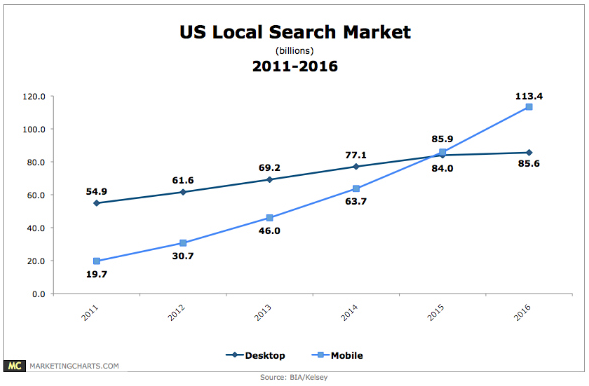
One of the most popular mobile activities is search. According to BIA/Kelsey, mobile searches will bypass desktop counterparts by 2015.

Source: https://www.marketingcharts.com/wp/direct/local-to-account-for-two-thirds-of-mobile-ad-spend-in-2016-21747/

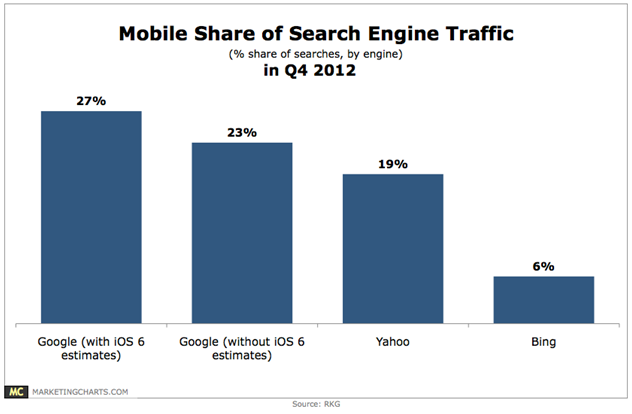
Most of the mobile searches happen on Google. RKG’s estimates 27% of Google searches will be via mobile in Q4-2013. Mobile share of organic and direct traffic is expected to rise as well.

Source: https://www.marketingcharts.com/wp/interactive/mobile-share-of-web-traffic-jumped-in-q4-2012-26057/

What do people search for? According to a February 2012 study done by Localeze and 15miles,  92% of US smartphone users look up information about local businesses on their mobile devices.  The same study shows that 86% of the local searches on tablets and almost 75% of mobile phone searches resulted in a purchase.

According to eMarketer, 20% of travelers in the US will make reservations on smart phones in 2013. Of course, in order to take a piece of the “mobile shoppers” market share, your website needs to be mobile accessible.  At Milestone, we see mobile traffic share anywhere from 25% to 42% on our clients’ sites. And the numbers are growing.

Moreover, cell phone users carry their precious devices with them all the time; and  according to Cisco Study, many check their devices every 10 minutes. A research done by Prosper Mobile Insights reveals that people are also planning to spend even more time on their mobile devices. The predicted number of people who plan to shop on their mobile devices has almost doubled in 2013.

If you are still not sure if you need a mobile website, the answer is a resounding “yes!”  The remaining question, however, is – in what kind of mobile website should you invest in?

Mobile website vs. Responsive design website

There are two options for you: mobile website and responsive design website.

Mobile website is a separate site, designed for mobile phones and mobile browsers.  It has a different overall design, sporting big buttons, click-to-call phone numbers, and lighter content that is focused for mobile user.  Mobile sites usually feature maps, directions, and simple forms.

The main benefit of having a mobile site is that you can target your mobile audience very well. You can put all the information they are looking for right at their finger tips. Your mobile site will work on smart phones as well as dumb phones.

The drawbacks are several.  Since your desktop site and mobile site are two separate entities, when you update your website, you will need to update your mobile site as well.  You will have to allocate internal resources for mobile site development and content re-writing and adjustment, like scaling down the images.  If you have a huge site, it might take a long time to scale the site down and determine what content to include in the mobile website. There are also some code adjustments you need to do for search engines. In addition, there are limitations on tracking your visitors and their actions on your mobile site.

If those drawbacks are deal breakers, then the second option might be best for your hotel.

Responsive Design – There are many benefits to responsive design. The main benefit is that once implemented, the website will scale based on what device was used by the visitor – desktop or laptop, mobile phone, or tablet.  Images, columns, navigation will all adjust to the device size and resolution, taking up the entire screen real estate. In addition, because you only have one single site, It requires little maintenance once implemented and is a good long term solution.  A responsive website benefits from exposure to all visitors – mobile or desktop – and steadily gains popularity on the website because of links and sharing.

Sounds perfect? Well, there are still some drawbacks.

The main consideration is that it will take a lot of resources to design and implement the new website layout. The first step is to define a fluid design and concept for the website. Next, the code and queries for responsive design must them be implemented on each and every page of the site. Yes, I mean it – each and every page. And because there are more codes, this can lead to higher download time. In this case, the site would need to be re-evaluated and adjusted to make it load faster.

But wait, that’s not it.  The website content then needs to be reviewed and edited to accommodate both desktop and mobile viewers. If the website has a lot of content, it will need to be reduced. It is important to be very selective about what content to keep and what can be deleted because every page can and will be accessible on every device. With a small screen and less time to browse, it’s important to present the most important content to mobile users. It is critical to have concise content, friendly navigation, and quick-loading images in order to delight mobile users.

There is an attempt by Google to help pick a mobile site solution for your business.  In their blog post, Google attempts to help businesses select the right solution by comparing available options.

What mobile solution is best for you?

Whether it’s responsive design or mobile website, it has to fit your business and your visitors.

We recommend responsive design if you have a small website that has similar goals for mobile and desktop visitors. It is also a good solution if your website has uniform content and not very complex.  If you are redesigning your website or just creating one, it might be a good idea to also invest in responsive design. One thing’s for sure – be ready for an extensive initial development.

If you have an established website, you might want to stick with your mobile site for now. When you are ready to redesign your website, plan for the extensive work on making your redesign responsive. Another reason to have a customizable mobile site is if your mobile visitors differ significantly from their desktop counterparts. If you, the business owner, have a different goal for those who use mobile devices to look at your website, you might be better off with a separate mobile website.

There isn’t a single “general” recommendation for a business mobile site.  Look at your business and select the appropriate option for you.

Milestone Internet Marketing offers both mobile sites and responsive design sites to our customers.   For more information about our mobile services or to get a pricing quote, call us at 408-492-9055 or email sales@milestoneinternet.com. We’d be more than happy discuss the options and pick the right solution that best fits your business’ needs.

This is reposted from the Milestone Internet Blog.


Is New Media Even Relevant to the Hospitality Industry?

New media in hospitality marketing is not evolutionary; it’s revolutionary. And its growth hasn’t been linear; it’s been exponential.

In the year 2000, less than 5% of hotel room revenue was booked online in the United States. By 2015, that number will balloon to over 35%, more if you include bookings by business travellers using mobile devices or their own PCs and even event attendees using software provided by the event organizers or the venues themselves.

In addition, Google became a publicly traded company in 2004 and today it represents more than 90% of search activities by users. Then in 2010, Facebook actually overtook Google in the number of weekly U.S. visitors. And finally, I’ll bet you have a mobile device in your pocket or on your desk right now, and a tablet in your possession or at least on your wish list.

New media (social, mobile, and search) is everywhere. It’s in the pockets, purses, desks, and living rooms of your potential consumers, helping them make decisions about their next purchase.

By leveraging these new connections to the target market, you are offering potential consumers the opportunity to engage with your brand in a more complete way than was previously available.  You are allowing customers to essentially “try” your product or property before even buying. For example: hotel web sites have evolved from kind of of the Web 1.0 version of online brochures to much more interactive sites where visitors can take virtual tours to explore property, they can play games, they can engage in virtual activities such as taking the participant’s view as they go down a water slide, or even watch short movies. Because there are so many new ways to connect with customers, creativity and uniqueness can be strong tools to set you apart from your competition.

New media is indeed relevant to the hospitality marketing industry. It is how you are going to project, promote, and protect your brand. And it is how you are going to capture more than your fair share of the desired target market.

The Evolving Online Course: Can a Course Get Smarter As It Ages?

Much has been written about Massive Open Online Courses (MOOCs) and their potential to change how people access course content, and discussions abound on how faculty might change their style of teaching and how learning might become more personalized. These questions are an extension of the ongoing dialogue related to the potential opportunities afforded by online education.

One of the untapped areas of potential for schools, faculty and students is how to best take advantage of the digital assets created during the development and delivery of online courses. If you begin to think “outside the box” of the traditional course, or even the traditional online course, you quickly identify a variety of potential issues with how we use, re-use and re-combine these digital assets, which could lie at the heart of a future transformation of the course.

What is a course and who owns it?

Faculty members have traditionally been good curators of content, aligning readings and guest speakers with their own lecture topics to create a unified course. The faculty member regularly updates lecture content, adapts new reading lists and chooses new textbooks as new material becomes available.

In the digital environment, the faculty member now has a much broader menu of options for course content, increasingly supported by the learning management system being used by his or her institution, which makes it easier to integrate, link and embed third-party content into the course. Some of these options take the more traditional form (such as e-textbooks and journal articles) while others include online assets such as blogs, wikis and RSS feeds. Over the past several years, faculty members have had access to content from various open educational resource repositories, as well as YouTube or iTunesU videos. Added to this list now are MOOCs, which could serve as rich course material sources or pre-requisites, depending on the platform being used. Lastly, the new format for online courses has led to an explosion of student-generated content. Student discussion posts, blogs, tweets, etc. from prior courses could also become a rich set of new content.

For administrators, the questions will arise:

  • “Where does the definition of what counts as course material stop and start?”
  • “What ownership does the faculty member have over the course, its content and its design?”
  • “How does this new world of aggregation change how we think about stipends and other compensation for course development?”

New opportunities for aggregation and social sharing

Indeed, some of these issues related to IP ownership, rights and access have been part of the discussion for many years. And, certainly, the creation of a fully digital course is nothing new in some circles. But where it gets really interesting is when you factor in the ability to aggregate the student-generated and socially-shared content of an online course.

One of the unique characteristics of an online course, compared with a classroom course, is the digital footprint created by the students and the faculty member. At eCornell, where we typically offer short courses (two to four weeks long), each session is still populated with hundreds of unique discussion posts and dozens of student-created projects, papers and other assignments by the end of the course. Recent attention and focus has been turned to the field of learning analytics and tools like Knewton that can help faculty identify students in need, and offer more targeted and personalized content based on the aggregation of data on the student’s progress in the course. While interesting in its own right, I think there is another, more interesting use of student data.

When we move beyond the binary distinctions of faculty member and student, and instead look at everyone as having the role of a contributor to the learning experience, you can ask new questions. What if you could systematically capture, tag, anonymize, analyze and aggregate the various types of student contributions to an online course, such as discussion posts, blog posts, tweets, projects and assignments? The result could be a new set of course assets, based entirely on the insights, wisdom and questions of students. In professional programs, you could create “Best Practices” or new types of Case Studies that draw on the real-world experiences of those in the class. As enrollments in a particular course grow (through a MOOC, for example), or as you aggregate contributions from multiple sessions of a course, you have the opportunity for a true “wisdom of crowds” type of learning experience.

In essence, what if a course could actually get “smarter” in each successive running, not solely based on the updates of the faculty member, but based on the knowledge, insights and experience of prior students? Imagine a course with new assets that could reflect recent trends drawn from the diversity of its students. This could could enable the construction of new knowledge in a way that is possible but may not be happening in a systemic way.

Of course, there are questions

Do the students have to explicitly consent to the use of their contributed materials in this way? What types of tools do we need to aggregate and analyze this unstructured “big data”? How should faculty members adapt their own teaching and content to best leverage this student-generated content? Are they comfortable with this latest evolutionary step, which turns them from “sage on the stage” to “guide on the side”? Do institutions see this type of learning as a competitive advantage or disruptive threat?

With so much hype about the disruptive potential of video-captured lectures (arguably a significantly old technology) and the transformative effects of blending digital content with human-powered learning (a not-so-recent development), I suggest we turn our attention to figuring out how to do things in the online environment that take advantage of its unique ability to capture learning that truly reflects the collective knowledge of the learning community.

Guest Post on The Evolllution


How Tech and Social Media Now Drive the Travel/Hotel Industry

I was in NYC last week, along with Hotel Administration Dean Michael Johnson, to present my new research on how travel review web sites and hotel-industry elasticity are forming a tidal wave of change in 2013.

We were at the Westin New York at Times Square in Manhattan, as part of the Inside Cornell series, a monthly series featuring researchers and experts working at Cornell University’s centers in Ithaca, Manhattan and around the world. Click here to view the video.